
Please read my disclosure policy to understand how I work with companies and individuals. Linking to a specific site does not imply endorsement of all of their services or content
The Biblical Mandate for Multicultural Church Worship Services
 We all long for a sense of belonging. In a world often marked by division, finding a community that celebrates unity across differences is more important than ever. Christian churches, designed to reflect God’s diverse kingdom, are uniquely positioned to offer this. This is the vision of a multicultural Christian church.
In this guide, we will explore what makes these churches truly transformative. We will look at the deep biblical roots of God’s desire for a diverse body of believers. We will also clarify the difference between a simply multiethnic congregation and a truly multicultural one, where every culture has influence. For those seeking to deepen their understanding of what this looks like in practice, particularly within worship services and Bible study, this guide offers insights. We will discuss common pitfalls and offer practical steps churches can take to build genuine unity. Our aim is to help readers understand how faith communities can move beyond mere demographic diversity. We want to show how they can become vibrant examples of God’s inclusive love.

The concept of a multicultural Christian church is not a modern innovation but a profound biblical mandate, deeply woven into God’s eternal plan. From the very beginning, God envisioned a kingdom that transcends human boundaries and celebrates the rich tapestry of His creation. This vision is rooted in the biblical truth that all humanity is made in the “Image of God” (Genesis 1:27), signifying inherent worth and dignity regardless of ethnicity or background.
Why does God desire a multicultural kingdom? We believe it is because a diverse kingdom beautifully images God’s love, which crosses all differences, to a world often fractured by tribalism. This love is not meant to erase our distinct identities but to unite us in a common purpose and worship. The New Testament provides powerful illustrations of this divine intention. The book of Revelation, for instance, offers a glimpse of the heavenly throne room where people “from every tribe and language and people and nation” worship God (Revelation 5:9-10). This prophetic vision underscores that diversity is not merely tolerated in God’s presence, but celebrated as an essential aspect of His glory.
A pivotal moment demonstrating this mandate occurred at Pentecost, as recorded in Acts 2. Here, the Holy Spirit empowered the early church with the miraculous ability to speak across language barriers. This event immediately created a multilingual, multinational community of thousands, making it arguably the first “megachurch” that embraced diversity from its inception. This outpouring of the Holy Ghost signified that the Church’s mission would inherently be global and inclusive, breaking down the very barriers that typically divide humanity.
Overcoming Tribalism Through Spirit-Led Church Worship Services
The event of Pentecost in Acts 2 wasn’t just a display of divine power; it was a foundational blueprint for overcoming humanity’s inherent tendency towards tribalism. The Holy Spirit’s immediate action was to grant the Church the ability to speak across language barriers, creating a community where people from different nations could understand and be understood. This supernatural act directly countered the natural human instinct to gravitate towards those who are similar in age, background, or ethnic group.
Our research indicates that tribalism is often the default human experience, a deeply ingrained tendency to form exclusive groups and view outsiders with suspicion. From a theological perspective, this tribalism can be seen as a manifestation of our sinful nature, hindering the unity God desires for His people. The church, empowered by the Holy Spirit, is called to offer a visible, supernatural alternative to this default. It is meant to be a place where the love of God actively crosses cultural divides, demonstrating a unity that the world cannot produce on its own.
The early church continued to grapple with cultural differences, as evidenced in Acts 6, where a dispute arose between Grecian and Hebraic Jews over the daily distribution of food. The apostles addressed this not by ignoring the cultural distinction but by appointing deacons from the Grecian community to ensure equitable care. Later, in Acts 15, the Jerusalem Council convened to resolve significant theological and cultural differences between Jewish and Gentile believers regarding salvation and dietary laws. In both instances, the church, guided by the Holy Spirit, sought solutions that honored cultural distinctiveness while upholding the core tenets of faith, rather than forcing assimilation or allowing division. These biblical examples illustrate that true spiritual unity, fostered through Spirit-led worship and intentional action, provides a powerful antidote to human tribalism.
Moving Beyond Demographics: Multiracial vs. Multicultural Communities

When we discuss diversity in the church, it’s crucial to distinguish between a “multiracial” and a “multicultural” congregation. While these terms are often used interchangeably, they represent fundamentally different levels of integration and influence.
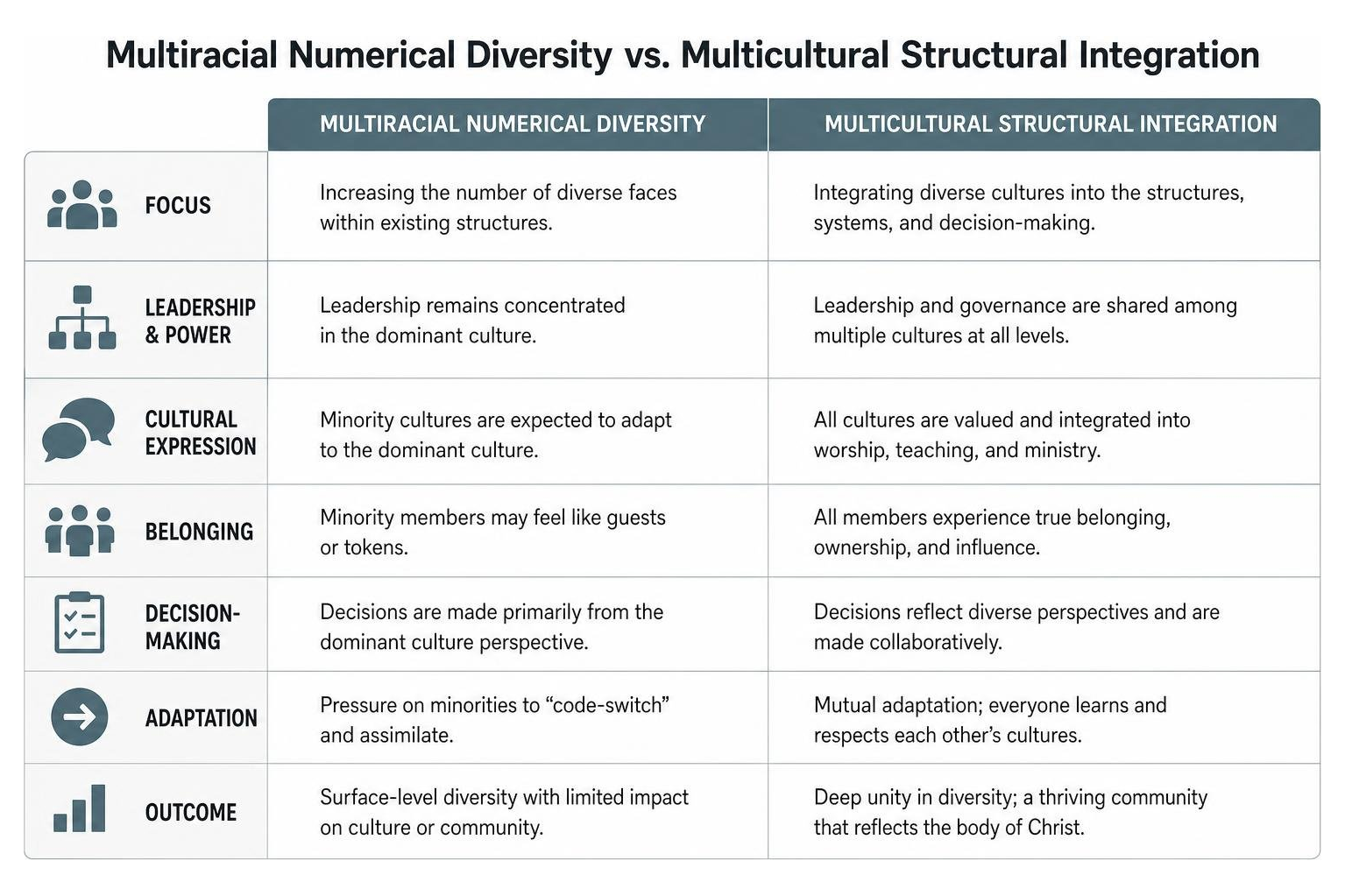
A multiracial church, by a popular metric, is one where no single racial or ethnic group comprises more than 80 percent of the congregation. Sociologist Michael Emerson defines it similarly: a multiracial congregation is one where no single racial or ethnic group accounts for 80 percent or more of the membership. This definition focuses solely on numerical diversity, the presence of different racial groups in the pews. While a step in the right direction, a multiracial church can still operate with a dominant culture, expecting minority members to assimilate to its norms, worship styles, and leadership structures. This often leads to what has been termed “multicolorism,” where diverse people are present but are implicitly or explicitly expected to conform to the prevailing cultural codes.
In contrast, a truly multicultural church moves beyond mere numerical diversity to deep cultural integration. It’s a community where multiple distinct cultures actively shape the church’s direction, leadership, worship, and theology. This means that power, influence, and decision-making are genuinely shared among different cultural groups, rather than being concentrated within one dominant culture. In a multicultural church, assimilation is not the expectation; mutual adaptation, or “code-switching,” becomes the norm for everyone. This involves members of the majority culture learning to adapt to the styles and communication patterns of minority cultures, and vice versa, fostering a dynamic environment of mutual respect and understanding. Without this intentional sharing of power and mutual adaptation, a church, though numerically diverse, risks failing to achieve genuine unity and may inadvertently place undue pressure on people of color to conform to middle-class cultural norms.
The Role of Shared Leadership in True Multiculturalism
The journey from a multiracial congregation to a truly multicultural one hinges significantly on the intentional diversification and sharing of leadership. It’s not enough to simply have diverse faces in the pews or even on staff if the core decision-making power remains concentrated within one cultural group. Our research highlights that many multiracial churches, despite their demographic diversity, often maintain a predominantly white leadership, leading to a phenomenon where minority staff might be hired for visible roles (like music ministry) but are still expected to conform to the dominant culture’s styles and preferences. This is a form of tokenism, where diversity is superficial rather than structural.
True multiculturalism demands that leadership diversity extends to the highest levels of the church, including governing boards, pastoral teams, and ministry directors. This ensures that multiple distinct cultures have genuine influence and leadership, rather than requiring assimilation to a dominant culture. Intentional leadership diversity means actively developing clear, attainable leadership paths for minority members, moving beyond mere representation toward shared governance. This approach aligns with the Apostolic vision of the church, where leaders are raised up from diverse backgrounds to serve the diverse body of Christ. When leadership reflects the congregation’s multicultural makeup, it fosters a sense of belonging, ownership, and authentic expression for all cultural groups, preventing the church from inadvertently becoming a place where minority members feel pressured to “code-switch” their identities to fit in. This commitment to shared leadership is a critical component in building a church that truly images God’s inclusive love.
Practical Strategies for Fostering Cross-Cultural Discipleship
Building a truly multicultural church requires more than just welcoming diverse individuals; it demands intentional strategies to foster cross-cultural competence as an integral part of discipleship. This means moving beyond superficial interactions to deep understanding and empathy across cultural lines. Our research suggests that developing cross-cultural competence must become a core part of Christian discipleship, equipping believers to navigate and appreciate cultural differences through the lens of biblical authority.
One practical step is to incorporate cross-cultural training into the core discipleship curriculum. This could involve workshops, seminars, or small group studies focused on understanding different communication styles, cultural values, and historical contexts. Such training helps congregants recognize that culture is much deeper than food or language; it influences communication, body language, social goals, and even views on God. For example, understanding that sarcasm might be offensive in some cultures, or that direct feedback might be perceived differently, can prevent accidental offenses and build stronger relationships. This approach ensures that spiritual formation includes developing the humility and wisdom needed to effectively love and serve people from all backgrounds.
Designing Unified and Culture-Specific Church Worship Services
A key challenge and opportunity for multicultural churches is balancing the desire for unified worship experiences with the need to affirm and celebrate distinct cultural expressions. The goal is not to erase cultural identity but to integrate it into the life of the church in meaningful ways.
One effective strategy is to create intentional culture-specific spaces alongside integrated multicultural spaces. For instance, a church might establish language-specific ministries—such as Chinese-language, Spanish-language, or African-American ministries—where minority leaders are empowered to design and lead programs that cater to their specific cultural and linguistic needs. These spaces allow for deep cultural connection and leadership development within those communities.
Simultaneously, the church should also develop intentional multicultural “fusion spaces.” These are gatherings or ministries, such as Sunday worship services and Bible study that are explicitly designed by diverse teams to ensure no single culture dominates. In these fusion spaces, worship music might incorporate diverse styles, sermons might draw on cross-cultural illustrations, and leadership roles are intentionally shared among different ethnic and cultural groups. This approach allows for both the affirmation of distinct cultural identities and the celebration of unity in diversity, reflecting the Apostolic doctrine of one body in Christ composed of many members. By creating both culture-specific and multicultural fusion spaces, churches can foster an environment where all feel valued, seen, and empowered to contribute their unique cultural gifts to the broader unity of the congregation.
Why Multicultural Ministries Fail and How to Prevent It
Many churches aspire to be multicultural, but the path is often fraught with challenges. Our research highlights several common reasons why multicultural churches fail, often stemming from a misunderstanding of what true multiculturalism entails.
One primary pitfall is the failure to move beyond “multicolorism” to genuine multiculturalism. A church might achieve numerical diversity (multiracial) but still expect minority members to assimilate to the dominant culture’s codes and styles. This pressure for cultural assimilation means that while diverse faces are present, their cultures, perspectives, and leadership are not genuinely integrated or valued. This can lead to tokenism, where minority members are included for appearance’s sake but lack real influence or power.
Another significant challenge is the inherent difficulty and slower growth rate associated with building genuine cross-cultural trust and understanding. Multicultural churches naturally grow slower than monocultural ones because it takes considerable time, humility, and effort to develop transparency, trust, and unity across different cultures. Without patience and intentionality, churches can become discouraged or revert to monocultural comfort zones.
To prevent these pitfalls, churches must:
- Prioritize Shared Power: Ensure that leadership and governance are shared among two or more culturally distinct groups, moving beyond token representation.
- Foster Mutual Adaptation: Encourage everyone, including the majority culture, to learn to “code-switch” and adapt to other cultures, rather than placing the burden solely on minorities.
- Integrate Diverse Cultural Traditions: Intentionally incorporate multiple cultural traditions into preaching, teaching, and worship on a daily basis, not just on special occasions.
- Invest in Cross-Cultural Discipleship: Make developing cross-cultural competence a core part of discipleship, equipping members to understand and appreciate diverse perspectives.
- Build Trust Intentionally: Recognize that building cross-cultural trust is a slow process requiring consistent effort, active listening, and a willingness to address conflicts with grace.
By proactively addressing these areas, churches can navigate the complexities of multicultural ministry and build resilient, genuinely inclusive communities.
Frequently Asked Questions About Multicultural Apostolic Churches
Building a vibrant, multicultural Apostolic Pentecostal church community often raises specific questions about how biblical doctrine and diverse cultural expressions intersect. Here, we address some common inquiries.
What is the biblical plan of salvation in a multicultural church?
The biblical plan of salvation, as taught in Apostolic churches, remains consistent across all cultures and is central to our unity. It is a universal message of hope and transformation. This plan, vividly demonstrated in the book of Acts, emphasizes:
- Repentance: A sincere turning away from sin and towards God.
- Water Baptism in the Name of Jesus Christ: This is for the remission of sins, signifying a death to the old self and a new life in Christ. This practice, rooted in Acts 2:38, is distinctively Apostolic and powerfully unites believers from every background under the authority of Jesus’ name.
- Receiving the Holy Ghost: The infilling of the Holy Spirit, often evidenced by speaking in tongues as the Spirit gives utterance, empowers believers for Christian living and service.
In a multicultural church, this plan of salvation is presented in ways that are culturally sensitive and accessible, ensuring that the core message of Jesus Christ resonates with every individual, regardless of their ethnic or linguistic background. The experience of the Holy Ghost transcends cultural boundaries, creating a spiritual oneness that binds diverse people together.
How does a multicultural church avoid forcing minority assimilation?
Avoiding assimilation is a deliberate and ongoing commitment for a truly multicultural church. It means actively valuing and integrating diverse cultural expressions rather than expecting minority members to conform to a dominant culture. Key strategies include:
- Shared Power and Leadership Diversity: As discussed earlier, ensuring that leadership roles, decision-making processes, and governance structures genuinely reflect the congregation’s cultural diversity. This means actively mentoring and elevating leaders from various ethnic backgrounds.
- Celebrating Cultural Expression: Providing space for different cultures to express themselves in worship, music, preaching styles, and community events. This could involve incorporating diverse musical genres, allowing testimonies in various languages, or hosting multicultural potlucks and celebrations.
- Mutual Adaptation: Encouraging all members, including those from the majority culture, to engage in “code-switching”—learning about and adapting to different cultural norms and communication styles. This fosters an environment where everyone contributes to creating a shared, inclusive culture, rather than a one-way expectation for minorities to adapt.
- Intentional Listening and Feedback: Creating safe spaces for minority members to voice concerns, share experiences, and provide feedback on how the church can better serve and include them.
By implementing these practices, a multicultural church can foster an environment where every individual feels seen, valued, and empowered to bring their whole cultural self to the body of Christ.
Why is water baptism in the name of Jesus Christ central to church unity?
For Apostolic Pentecostal churches, water baptism in the name of Jesus Christ is not merely a ritual but a foundational act of obedience and spiritual identification that profoundly contributes to church unity. This practice, directly commanded in Acts 2:38 by Peter (“Repent and be baptized, every one of you, in the name of Jesus Christ for the forgiveness of your sins. And you will receive the gift of the Holy Spirit.”), signifies several crucial aspects of our faith and unity:
- Identification with Christ: Being baptized in Jesus’ name connects believers directly to His death, burial, and resurrection, symbolizing a new life in Him. This shared experience transcends all cultural and ethnic distinctions, making every baptized believer part of one spiritual family.
- Obedience to Apostolic Doctrine: This specific mode and formula of baptism are rooted in the original Apostolic teaching and practice. Adherence to this biblical doctrine creates a strong theological bond among believers, regardless of their cultural origins.
- Spiritual Oneness: As believers are immersed in water in the name of Jesus, they are united into one body, the Church. This spiritual oneness is deeper than any cultural tie, fostering a profound sense of belonging and shared purpose that strengthens the multicultural fabric of the congregation.
In a multicultural church, this common experience of baptism in Jesus’ name serves as a powerful reminder that our primary identity is in Christ, uniting us in a spiritual bond that overcomes all earthly divisions.
Conclusion
The vision of a multicultural Christian church is not just an ideal; it is a biblical imperative and a powerful witness to a fractured world. As we have explored, God’s desire for a diverse kingdom is evident from creation to the prophetic vision of heaven, where every tribe and tongue will worship Him in unity. Moving beyond mere demographic diversity to true multiculturalism requires intentional leadership, shared power, mutual adaptation, and a deep commitment to cross-cultural discipleship.
While the journey to becoming a truly multicultural church presents unique challenges—from overcoming inherent tribalism to navigating cultural differences—the rewards are immeasurable. Such a church provides a vibrant, authentic community where every individual is valued, their cultural heritage is celebrated, and the full spectrum of God’s glory is reflected. By embracing the biblical mandate for diversity, we fulfill God’s purpose for His Church on earth. We believe that by intentionally seeking Jesus Christ and allowing His Spirit to guide us, our churches can become beacons of unity, offering a genuine sense of belonging to all who seek community and spiritual connection. The future of the church, in July 2026 and beyond, is undeniably multicultural, reflecting the beautiful diversity of God’s people.

